
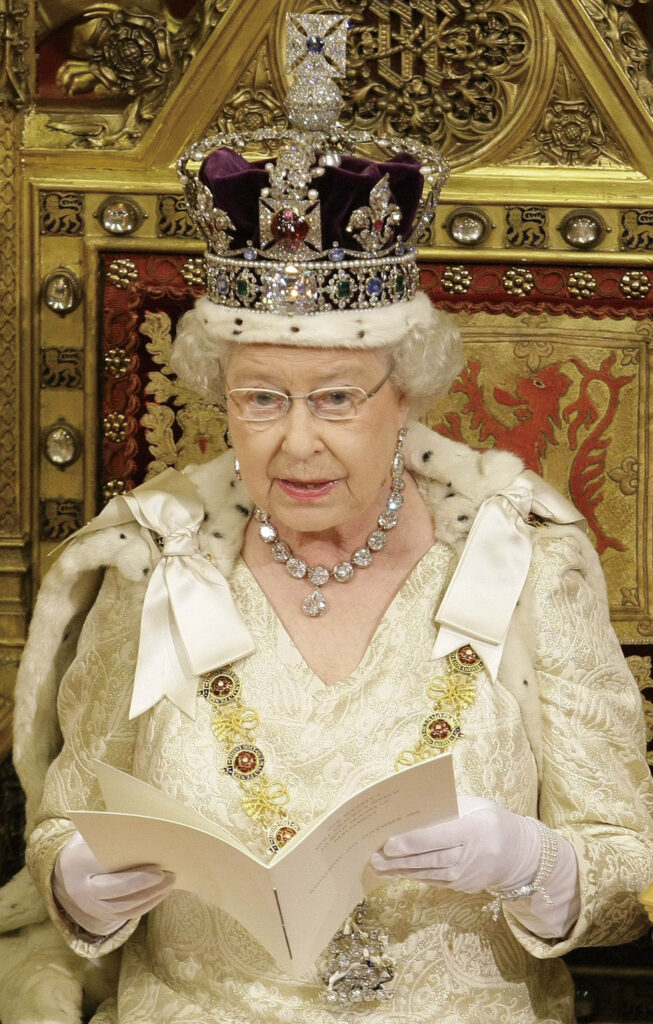
Do you know if the Queen has a diamond crown?
I will not write the answer here. I do not want to deprive you of the pleasure of finding the answer yourself in the new book on the history of the Elizabeth II diamonds published by the Royal Collection.
But here’s a little hint: two of them were given to you upon your marriage in 1947, one from your grandmother, Queen Mary, and the other from Nizam of Hyderabad; you received two in 1953 when Queen Mary died, and at least five when your mother passed away in 2002. I am sure you can all get a rough idea of what to expect from this.
This book by Hugh Roberts answers most of the questions we wanted to know about Elizabeth II’s lavish jewelry.
For example, do you know what gifts the wives of English kings have been given at their coronation for about a century? Kings Edward, George, and others have traditionally given their wives a necklace of large diamonds.
Queen Elizabeth II wore her own coronation necklace, the Queen Alexandra Legacy Necklace, to the coronation of her daughter Queen Elizabeth II. The necklace had been passed down from the Duchess of Teck to Queen Alexandra many years earlier. Over the generations, Queen Mary, the current queen’s grandmother, came to own a necklace of eight diamonds, sometimes wearing several at the same time. The oldest of these diamonds dates from the reign of King George III. He was known as the Mad King and died after a period of seclusion at Windsor Castle.
Some of his wife Queen Charlotte’s diamonds have been passed down to the present queen as brooches and Russian-style crowns. Other diamonds were received by Queen Victoria as official gifts and carried by her during her coronation, including the famous brooch, a gift from the Turkish Sultan, although Queen Elizabeth II only used a “slightly lighter” version of this brooch. Elizabeth II only used a “slightly lighter version” of this brooch.
This is because Elizabeth II, in contrast to her mother, grandmother, and great-grandmother, preferred simple jewelry. Only one series of diamond necklaces at a time. Some gemstones were used only once. Take, for example, the brooch worn on the front of Queen Mary’s torso. This large brooch had three strands and was so large that they were attached one by one with pins.
On the contrary, it is the engagement ring that the queen wears always on her person, and it is the jewel to which she is most attached. The book explains how this ring was made. The book also shows how old jewels that we thought were lost or transformed into other forms have actually been lying dormant in the palace vaults for decades, which will surprise you. Queen Mary’s love trophy, the choker, is one of them.
Queen Elizabeth II inherited this necklace in 1953, but never wore it because it was not to her taste. We can only imagine how perfect this choker would look on the Duchess of Cambridge. Kate would also look great with Queen Mary’s Matinee diamond necklace. This necklace was made in the 1920s and uses the stones from a string of diamonds (another one!) purchased by Queen Mary from the descendants of Grand Duchess Vladimir. The stones are from a necklace of
For 60 years, the necklace has been completely hidden from the public eye, but you can see it in the photographs in this book, along with over 80 other photographs of treasured gems. This book (and summer exhibition) is dedicated exclusively to the Queen’s magnificent collection of diamonds. It is unique in the world. However, none of the Queen’s numerous collections of rubies, emeralds, or sapphires are presented in this book. Perhaps a second volume of the same series, and a second exhibition, may be seen in the future…
❶ The shape of the brim is slightly folded back at the edges with a co-woven purple at the top. The wide black brim is made of translucent raffia, creating a lightness. The balance between the overall form, the volume of the color scheme, and the texture of the material is a masterpiece.
❷ Straw hats, which tend to be casual, become so formal when they are molded and worked in a linear design that takes advantage of the texture of the material.
❸ Royal blue toque. With its high front form, the glossy velvet ground enhances the sense of prestige and quality, and represents an exquisite sense of unity.
❹ A soft, mimosa-colored outfit. White raffia is placed inside the brim to give it a sense of transparency. The reason why this color scheme does not look bulky is because the boxy lines of the hat suppress the spread of color and create a clean impression.
❺ This winter toque hat has a large, high crown. The black leather lines from the vertical and horizontal sides are effective and exquisite accents that make the overall look tighter and less bulky.
❻ A dressy silhouette with a sense of presence. It is draped with lustrous silk satin and has piped edges for a stately feel.
❼ Emerald green with a straight line of black leather material placed in the insert color, with a core of ostrich feathers adding sharp lines. The warped prims on the left and right sides are unequal, capturing different expressions from different angles.
❽ Fur that gently cradles your face. No matter what material or form, it does not detract from the Queen’s dignity, and everywhere you can feel the traditional universality of the British Royal Family.
❾ The unity of color, including the color of the hair and the pearls in the earrings, and the calculated three-dimensional shading of the materials and forms make a monochromatic outfit, which tends to be ambiguous, gorgeous.